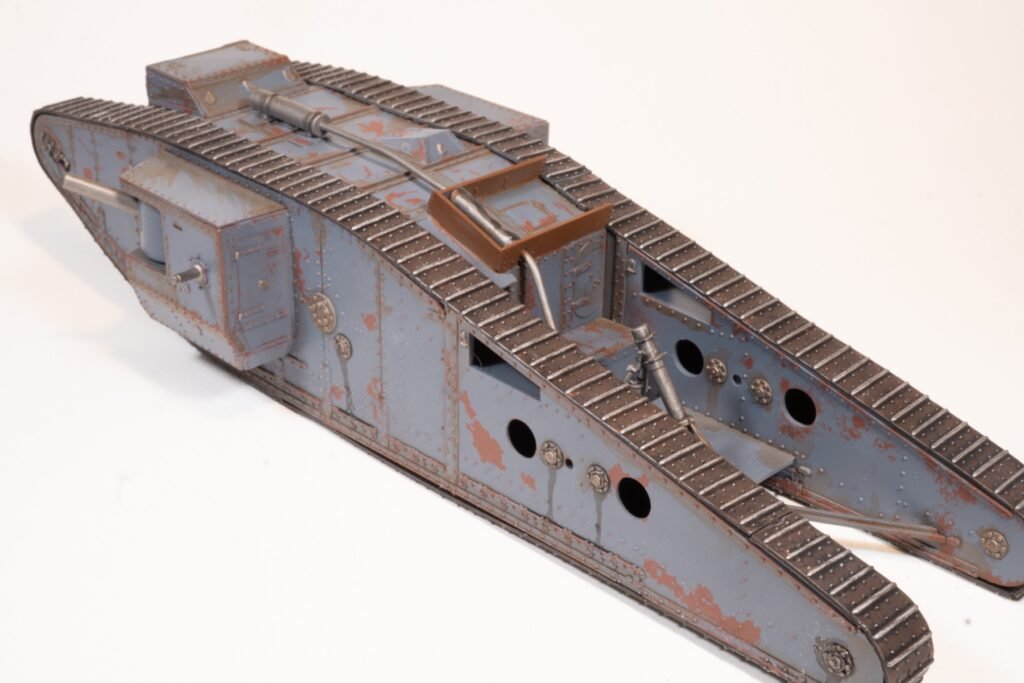
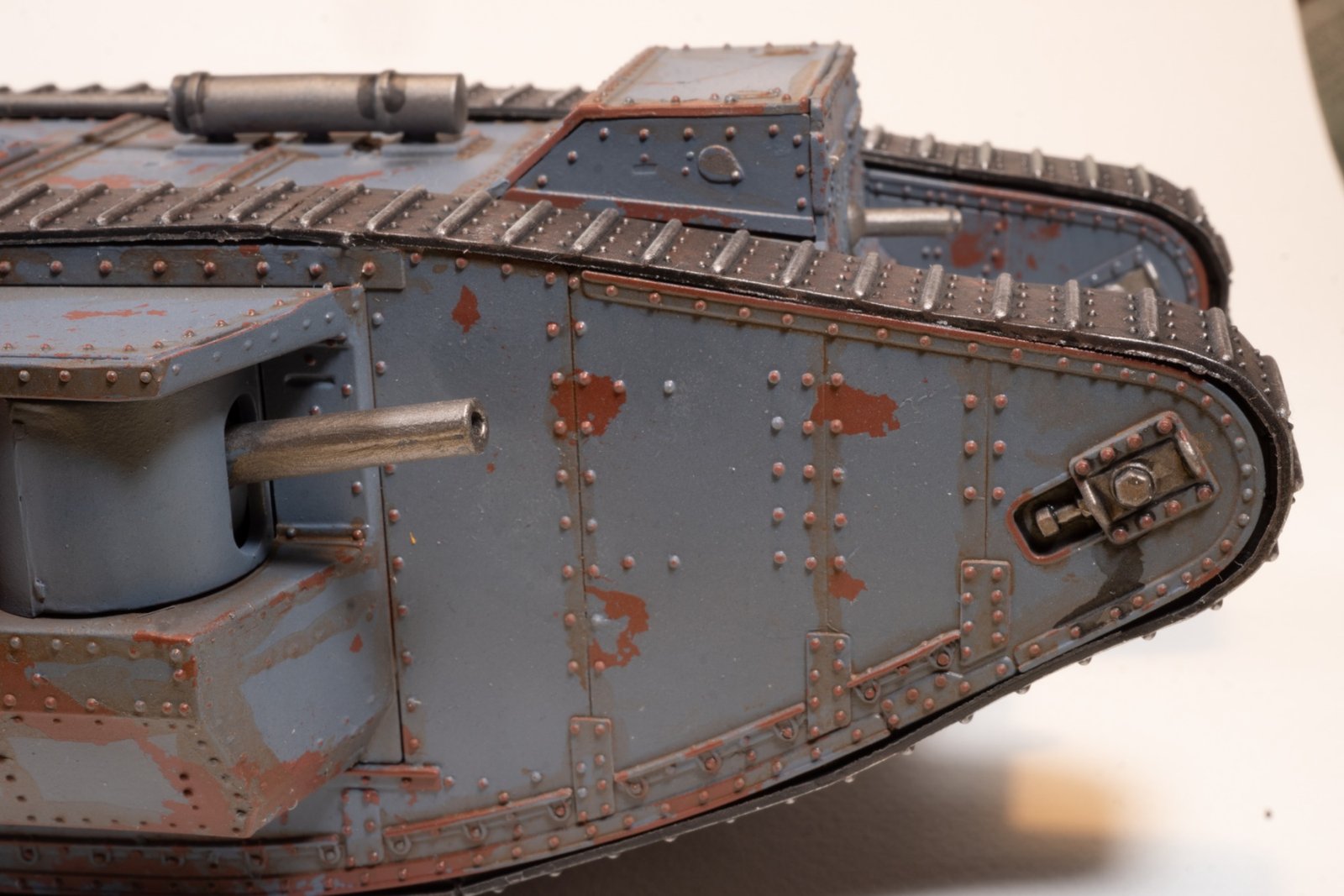
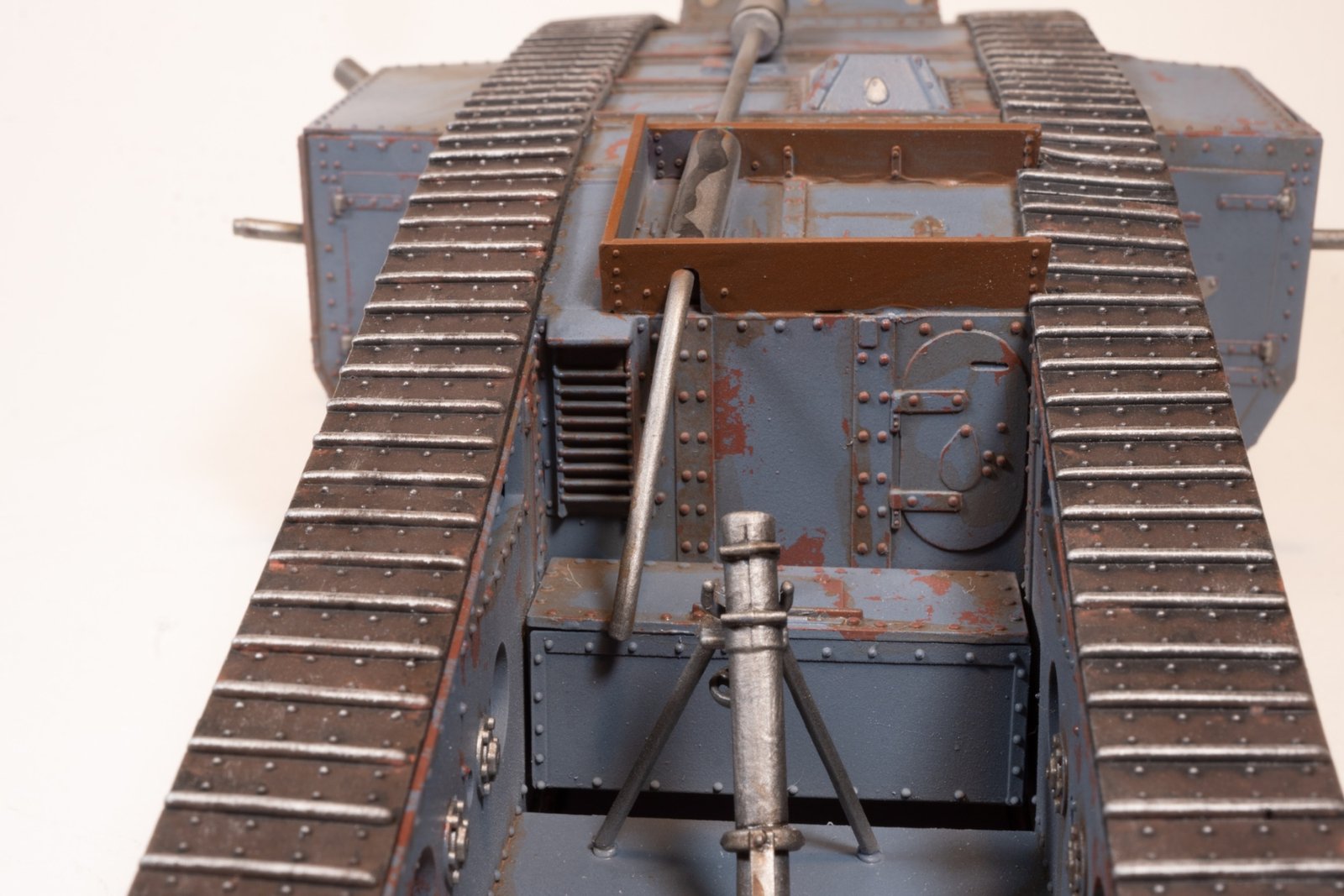
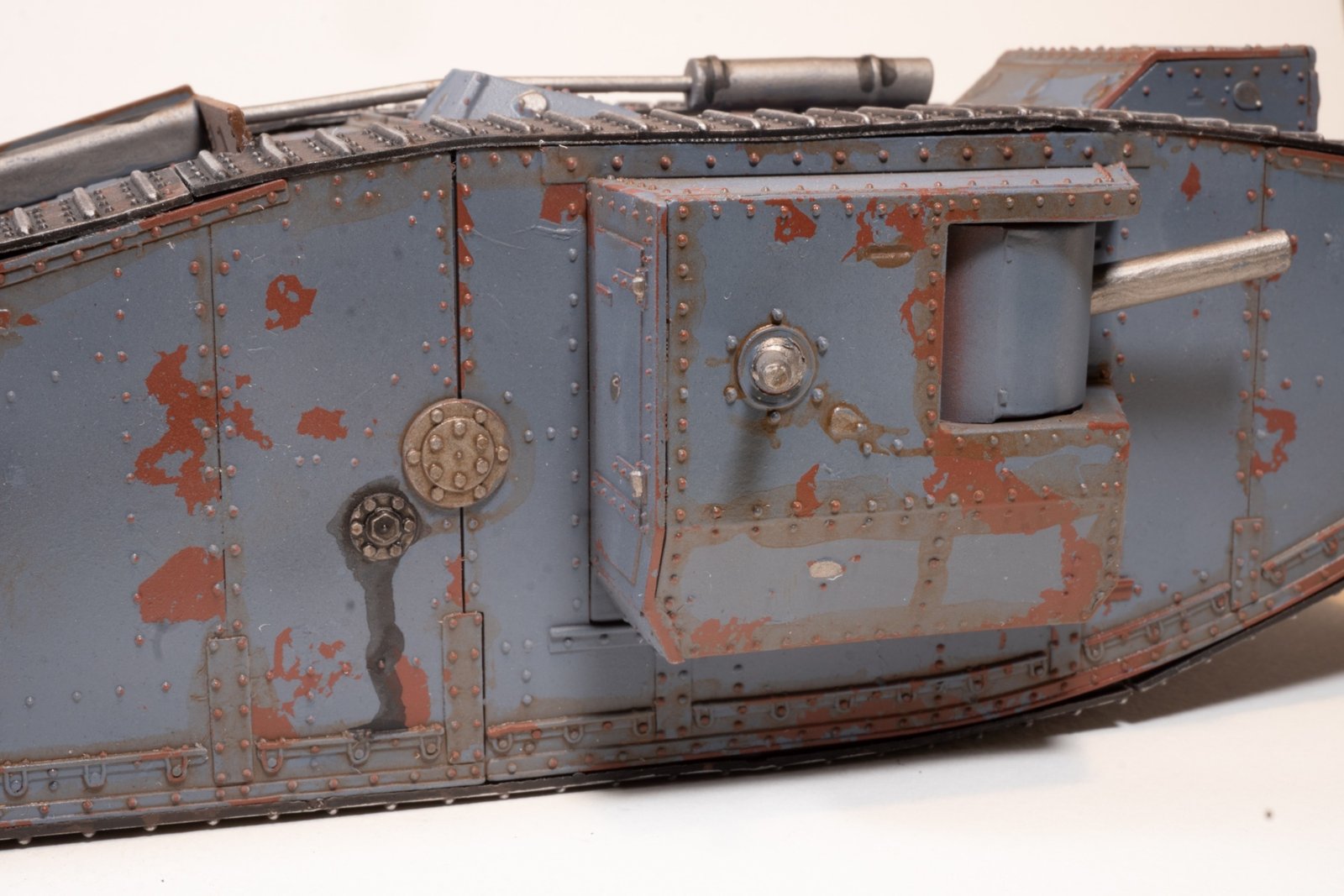
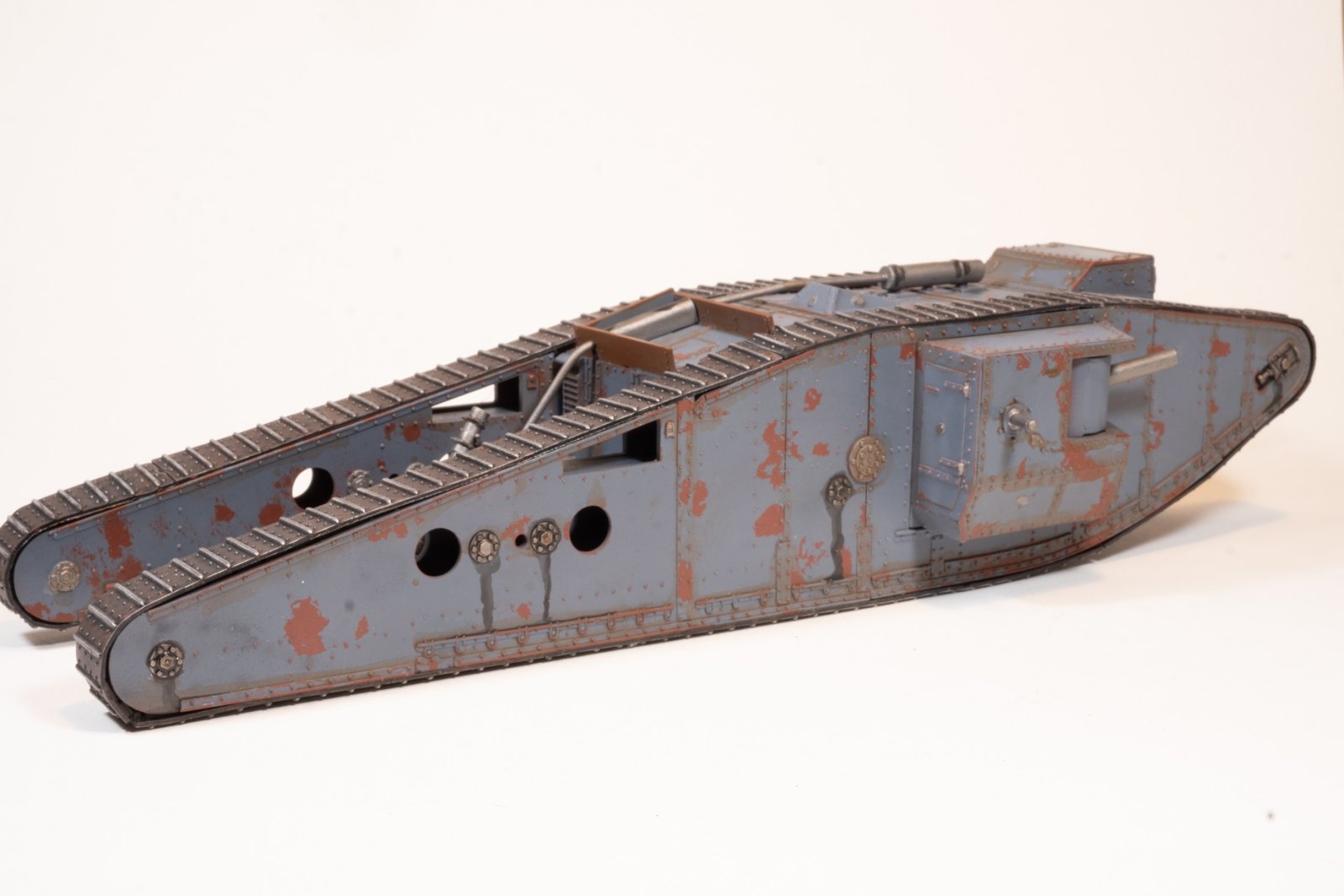
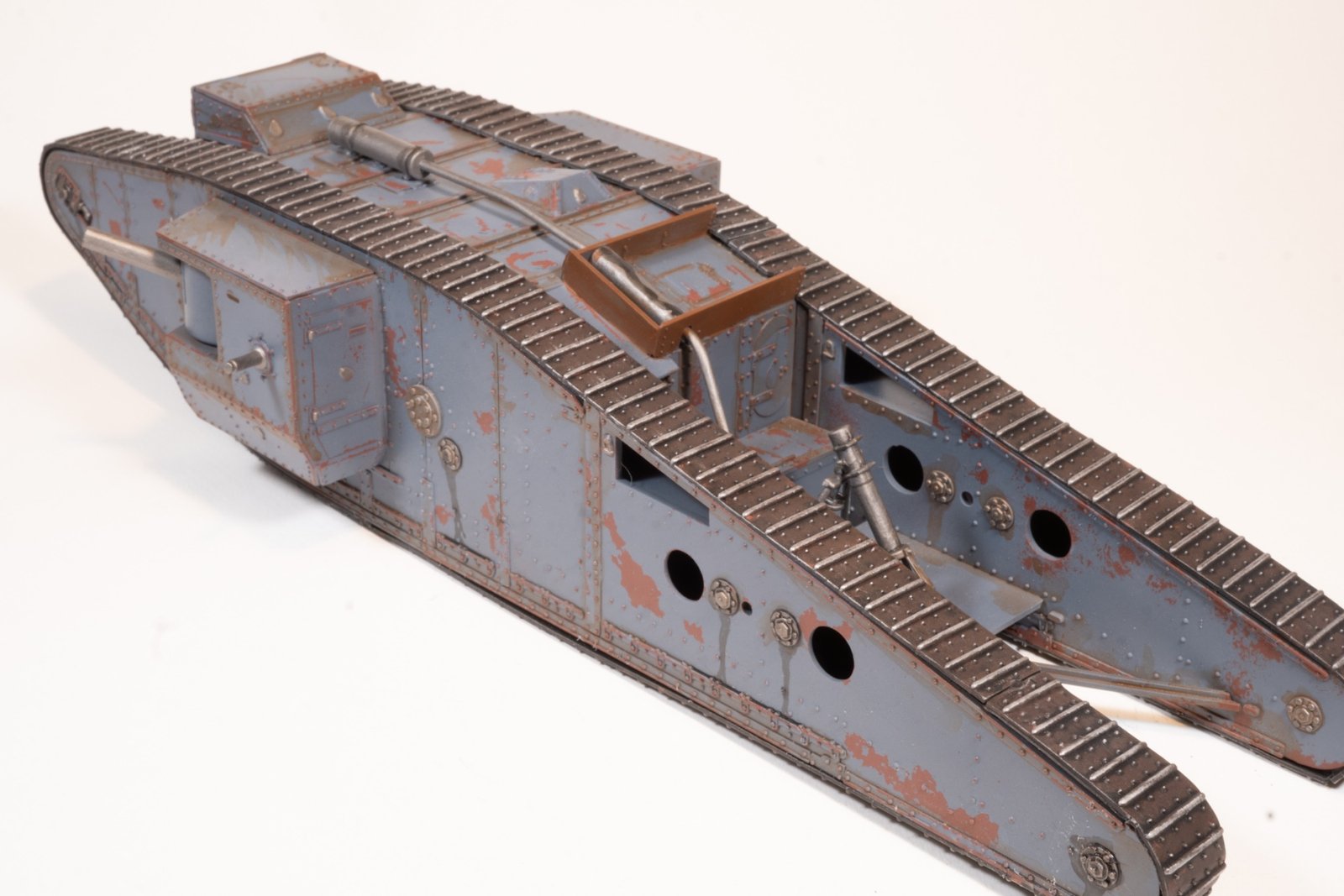
Off the Bench on April 9, 2023 – British Mark IV WWI Tank – Tadpole variant shown
The Mark IV (pronounced Mark four) was a British tank of the First World War. Introduced in 1917, it benefited from significant developments of the Mark I tank. A total of 1,220 Mk IV were built: 420 “Males”, 595 “Females” and 205 Tank Tenders (unarmed vehicles used to carry supplies), which made it the most numerous British tank of the war. The Mark IV was first used in mid 1917 at the Battle of Messines Ridge. It remained in British service until the end of the war, and a small number served briefly with other combatants afterwards.
The Mark IV Male initially carried three Lewis machine guns – one in the cab front and one in each sponson and a QF 6 pdr 6 cwt gun in each sponson, with its barrel shortened as it had been found that the longer original was apt to strike obstacles or dig into the ground. The sponsons were not mirror images of each other, as their configuration differed to allow for the 6 pdr’s gun-layer operating his gun from the left and the loader serving the gun from the right. The guns had a 100 degree arc of fire but only the starboard gun could fire straight ahead. The Female had five Lewis guns but no 6-pounders.
The decision to standardize on the Lewis gun was due to the space available within the tanks. Despite its vulnerable barrel and a tendency to overheat or foul after prolonged firing, the Lewis had the advantage that it used compact pan magazines which could hold up to 96 rounds. The Hotchkiss was fed from a rigid strip which was trimmed down to only 14 rounds for tank use; no sooner had the machine gunner guided the fall of shot onto the target than it was time to change the strip and the process repeated. It was not until a flexible 50 round strip was fully developed in May 1917 that the Hotchkiss would become the standard machine gun for tanks again. The changes caused delays, such as adapting the design for the bulky Lewis cooling barrel, and later, problems when the Hotchkiss strips had to be stored in positions designed for Lewis gun magazines.
At the 1917 Battle of Cambrai, Mark IV tanks were equipped with fascines, bundles of brushwood bound with chains, about 10 ft (3.0 m) long and 4 ft 6 in (1.37 m) in diameter carried on the roof of the cab. They were dropped into trenches to allow the tank to cross over more easily.
TadPole Variant
A large number of these tanks were also used for development work. In an attempt to improve trench-crossing capability, the “tadpole tail”, an extension to the rear track horns, was introduced. However, it proved insufficiently rigid and does not appear to have been used in combat. Other experimental versions tested radios, mortars placed between the rear horns, and recovery cranes. Some of these devices were later used on operational tanks.
Mark IVs were also the first tanks fitted with “unditching beams” by field workshops. A large wooden beam, reinforced with sheet metal, was stored across the top of the tank on a set of parallel rails. If the tank became stuck, the beam was attached to the tracks (often under fire) and then the tracks would drag it beneath the vehicle, providing grip.
Crew: 8
Combat weight:
Male: 28 tons (28.4 tonnes)
Female: 27 tons (27.4 tonnes)
Armour: 0.25–0.47 in (6.1–12 mm)
Armament: Three machine guns and two 6-pdrs (Male), Five .303 Lewis light machine guns (Female)
Ammunition storage: 6 pounder: 180 HE rounds and remainder Case